

Every morning, Claire Polcrack tacks the day’s number to a bulletin board in her office at Amistad High School.
The board is covered with numbers and graphs. All together, it amounts to a sort of portrait of the previous week at Amistad. Polcrack and other leaders meet to review these numbers every morning. They can see which students are falling behind and which teachers are having the greatest impact. They can see when, where and why students are removed from class for behavioral reasons.
The meeting lasts only ten minutes, but it allows everyone to stay focused on the students and issues that most need their attention. It’s one reason that Amistad, and the Achievement First charter school network of which it’s a part, have developed a national reputation for using data to great effect.
“It’s hard to think of anywhere I don’t use data in my classroom,” said Jen Tillotson, 10th grade geometry teacher.
Tillotson constantly tracks her students’ progress, drawing from mini-assessments at the end of every lesson, as well as a series of tests throughout the year. “On a daily basis, it’s about little adjustments,” she explains. “If my students didn’t get it, what’s the one thing I’m going to focus on tomorrow?”
At other points, the entire school steps back to look at data and establish priorities. The staff have full professional development days, known as “data days,” devoted to analyzing the results of quarterly school-wide exams.
Amistad’s use of data extends beyond test scores as well. Last year, the school was working on transition periods, the times when students are between classes. Slow transitions meant less time for learning, so teachers began recording the amount of time it took for students to be seated after the start of lunch. They eventually got it down to one minute.
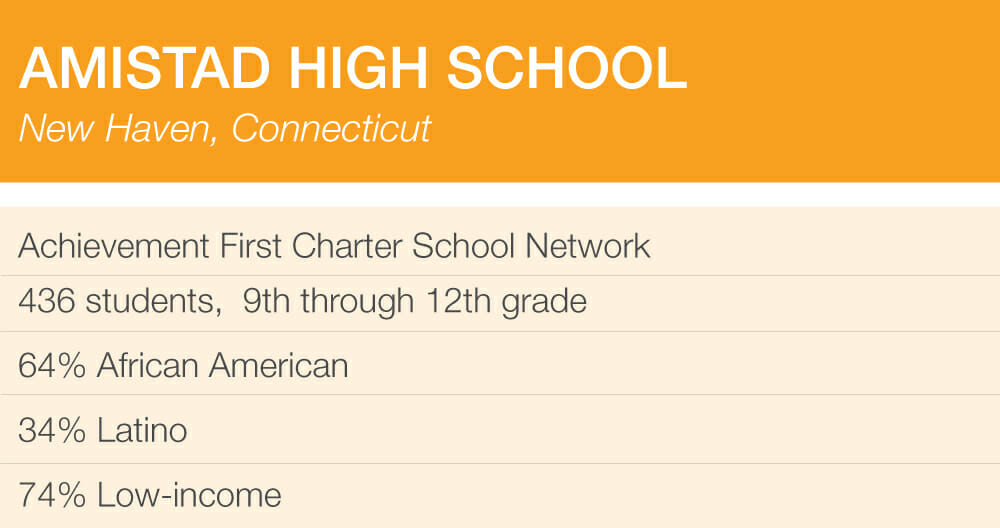
Data for 2015-16. Current as of November 1, 2015. Achievement First internal statistics. Retrieved 11.1.15.
The school also has a merit system awarding students points for behavior that aligns to the school values. Every week, students get a report evaluating their performance in the last week.
The focus on character education helps maintain a broader lens, balancing students’ academic and social emotional development. Even more critical, Polcrack says, is that the school’s objective is not test scores but what they indicate, which is an extremely high level of rigor in every classroom.
“Rigor doesn’t just mean difficult,” Tillotson said. “But rather challenging, feasible, and aligned with what students are supposed to be learning.”
This article is part of our report, “How World-class Schools Deliver for All Students,” which includes our framework outlining six key practices that drive the success of the highest-performing schools. Explore the report to read more school profiles showing what these practices look like in action.