

A young man in a suit rises and stands before a panel of judges.
For an hour, he walks through the challenges he faced in his past four years of study and how he took them on. He goes in-depth in explaining his academic work, including graphing parabolic functions and research into federalism in American politics and presents his digital media portfolio, fielding tough questions throughout.
He isn’t presenting his college thesis – he’s a senior at Impact Academy of Arts and Technology in Hayward and he’s presenting his final portfolio defense.
The stakes are high. He must pass to graduate. If he doesn’t make it tonight, he will have to go back, prepare and practice more and then do it again.
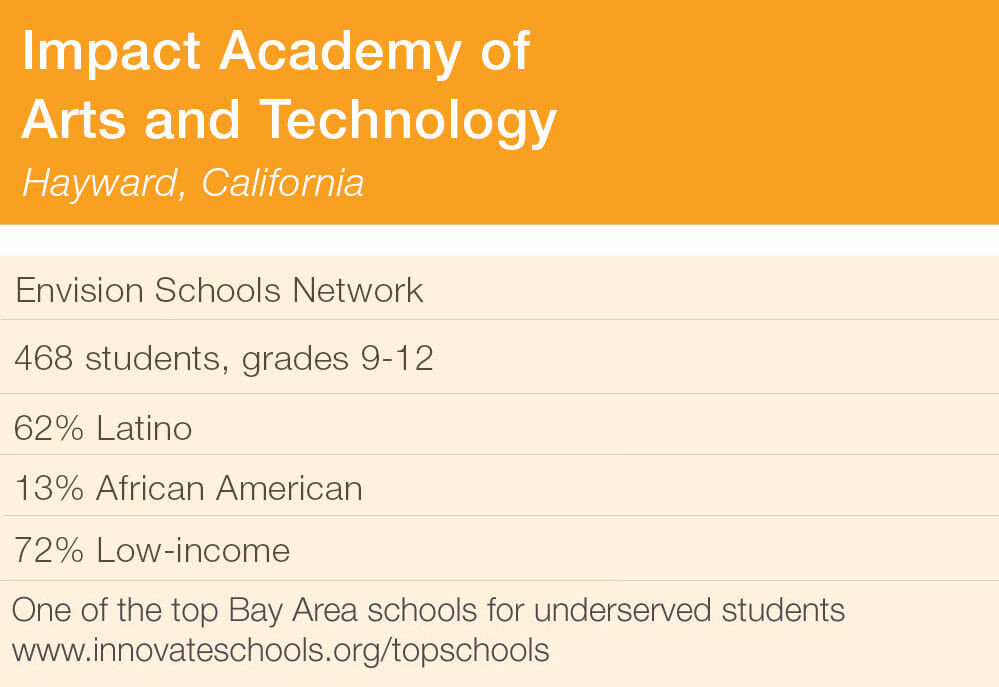
**Data for 2014-15 school year. 2015 California Statewide research file. California Department of Education. File creation date 9 October, 2015. Accessed 14 January, 2016. http://caaspp.cde.ca.gov/sb2015/ResearchFileList
“Portfolio defense is the tip of the iceberg. Everything that is underneath the surface is what makes it work,” says Ben Cornell, COO and Executive Director of Envision Learning. Envision runs three charter schools in the Bay Area and also helps other schools across the country implement their portfolio defense model.
Impact’s approach helps students not only master tough academic content, but develop the learning mindset to take on challenges and persevere that they’ll need to get to and through college. Expectations are high, but so is the support for students, who do their first portfolio defense to advance from 10th grade to the upper grades, then again to graduate.
“They prepare you mentally. ‘You are going to college. These are your options. If you work hard, you will broaden your goals,” says junior Francisco Rodriguez. “[Going into your portfolio defense], the teachers know you’re ready. You have to convince yourself you’re ready.”
At Impact, 73 percent of students will be first in their family to go to college. The average reading level for incoming freshman is seventh grade, with some students coming in at just a second or third grade reading level.
Due to funding and facilities constraints, Impact doesn’t look like a typical high school. There’s no library or gym, the traditional ways that high schools might build their school’s identity.
Impact Principal Sean McClung says that relationships and a culture of learning that extends to staff make Impact what it is.
Building Strong Relationships
Students have an advisory period with the same teacher and students for two years in a row, which allows them to build strong relationships with their teachers and each other. During this time, they also build up study skills, develop their leadership and prep for their portfolio defense. In the upper grades, students also leverage advisory time to research colleges and prepare their college and financial aid applications.
“This school is tough, but the teachers engage you,” says student Katherine Velazquez. “They’re devoted to your learning. When you have that kind of support, you don’t want to let them down.”
All students at Impact must take and pass the A-G classes required for entrance to a California state university. They take a familiar line-up of math, English, science and history classes, then have projects that stretch across multiple subjects 1-2 times a year.
In a recent election simulation, they were dissecting the rhetoric of candidate’s speeches in English class, while in Government, they dug into the electoral process and the role of the media and special interest groups. At the end, each student had to pull together a cross-curricular project.
Students say they appreciate having time to explore subjects in depth and that teachers make projects relevant to current events.
“If our hearts are invested in it, our minds will be, too,” says senior Mahdari Rhodes.
A Culture of Learning for Both Students and Staff
In 10th grade, students present their first portfolio defense, preparing them for senior year.
“I was speaking for an hour about what I had done. At first, the feedback was demoralizing. Then I realized it was helping me get better,” Rhodes says.
This culture of taking on challenges, getting help from others and learning extends to the adults at the school.
“[As teachers], we are demonstrating that we are constantly learning and we work together and model that for the students,” says McClung.
“It’s not easy being a teacher at Envision – developing projects, being an instructor and an advisor,” says Gia Truong, Chief Executive Officer of Envision. “The really strong adult culture is what keeps teachers at the school. People here feel they have support. When you have leadership that is distributed, things work better. The same processes that work for students work for adults.”
Perhaps most telling of Impact’s culture is that their graduates often come back to visit.
“It’s hard to pinpoint one thing because it’s in everything,” says Katherine Velazquez, when asked what makes her school tick.
And how well does this experience prepare students for college?
Katherine’s older brother graduated from Impact and is now at CSU East Bay.
“He tells me, ‘sometimes I feel like I’m at Impact again.’”
Principal Sean McClung was part of a panel at Innovate’s Celebration of Top Bay Area Schools for Underserved Students. Hear what he had to say.