
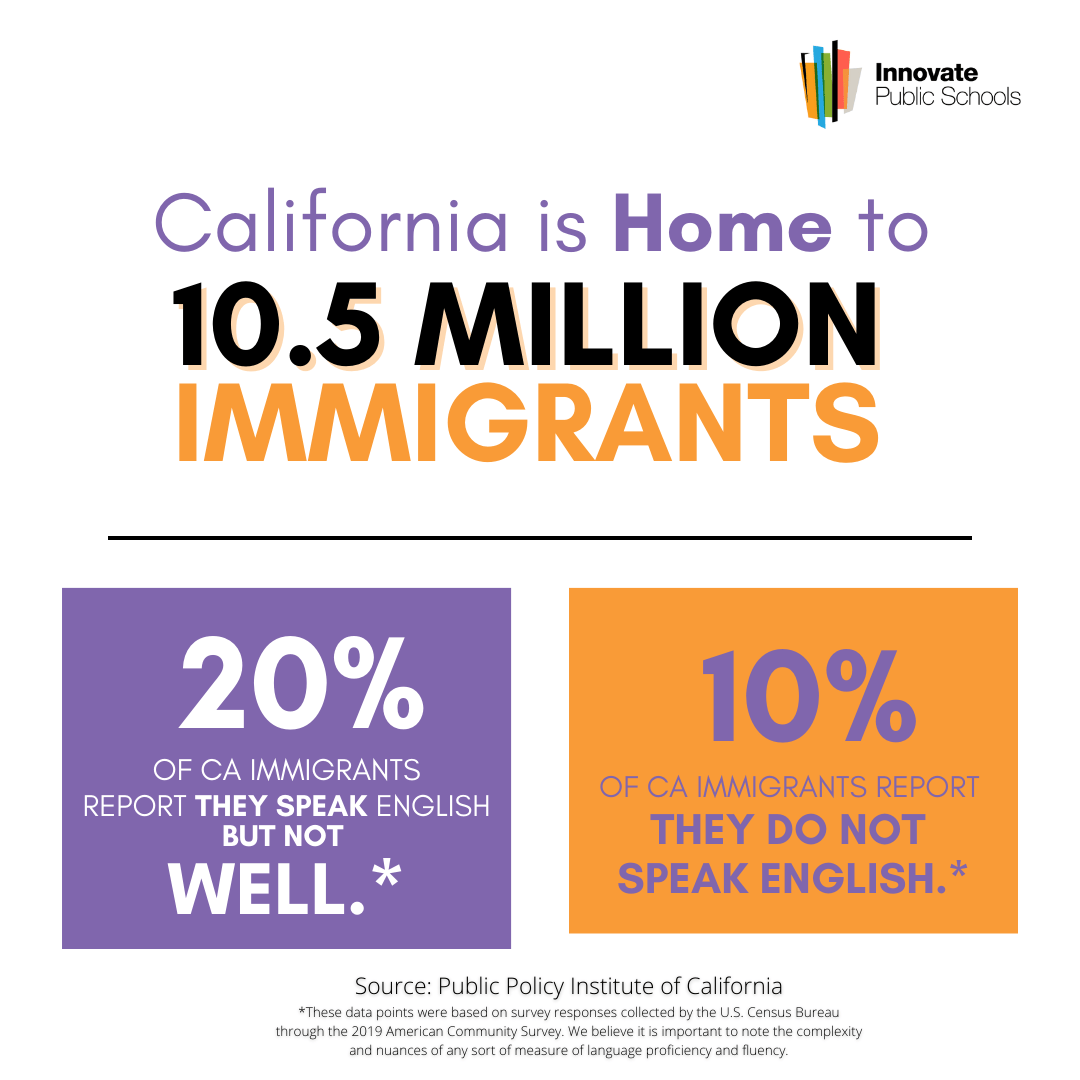
According to the Public Policy Institute of California, California is home to 10.5 Million Immigrants, twenty percent of CA immigrants report they speak English but not well and ten percent of CA immigrants report they do not speak English. While state law requires districts and schools to provide translated Individualized Education Plan (IEP) documents, the problem occurs when they do not provide the translated IEP in a timely manner and by a qualified translator.
“The translation of documents and student assessments could take up to three months to a year, making it difficult for me as a parent to advocate for my child.”
Rosario Gonzalez, SF Parent Leader and parent at Monroe Elementary School.

According to the National Center for Education Statistics, there are more than 773,000 students in California with IEPs. Without adequate access to translation and interpretation, parents and guardians cannot fully participate in the IEP process nor give informed consent, which may significantly delay and/or limit the services and support that their children receive. Holding LEAs accountable to providing accurate and timely translations of IEPs is crucial to ensuring that parents have the resources needed to both advocate for their child and fully participate in their child’s education.
The purpose of the blog is to give information about a bill to help parents and guardians advocate for children with IEPs by being armed with the knowledge needed to successfully navigate the IEP process. SB 445 would require local educational agencies (LEAs) to provide parents or guardians with a translated copy of the IEP including any revisions, within 30 days of the IEP meeting, if requested, or within 30 days of a later request, if the translation requested is in one of the top eight non-English languages in the district. The bill would also require IEP documents to be translated by a qualified translator, as defined in the bill.
The IEP Process
The IEP process has many steps and can be very overwhelming and intimidating for a parent, guardian, or educational right holder who is not familiar with the process or terminology. Especially if that person’s first or home language is not English.
To receive special education services a parent(s), guardian(s), or educational rights holder(s) must request that their child be assessed for special education services, after which if it is concluded that a student qualifies for services, an IEP is developed and agreed upon. The IEP is a written statement and legal document that describes a child’s present levels of performance, learning goals, school placement, and services.
SB 445 will ensure parents fully understand and can navigate the IEP process by receiving translated IEP documents within 30 days of request by a qualified translator, as defined in the bill.
The Bill-SB 445
The bill would require LEAs upon request by a parent to translate the completed IEP within 30 days of the request. The 30 day timeline applies when the translation request is for one of the top eight most commonly used languages within the LEA, usually about 15 percent of the student population.
The bill requires translation to be done by a qualified translator. A team of individuals work together to develop the IEP. An IEP team can include: teachers; parent(s), guardian(s), or educational right holder(s); other school representatives; a qualified person who can assess students with disabilities; and a translator.
Further, in accordance with the Chanda Smith Modified Consent Decree, the state’s largest school district, and the second largest nationwide, Los Angeles Unified, is already obligated to translate IEPs into the district’s primary languages within 30 days.


On a local level
Innovate Parent Leaders have been organizing around special education issues for many years. At the local level in San Francisco, parents moved forward a similar proposal that can serve as a proof point for the legislature at the state level. Innovate parent leaders advocated for and worked with San Francisco Unified Commissioner Alexander to introduce and pass a policy that would ensure translation and interpretation services are provided to parents and guardians whose preferred language is not English. That policy was unanimously approved by the Board in Spring 2022. Since then, parent leaders have continued to meet regularly with SFUSD Commissioner Alexander and Head of Special Education Jean Robertson to continue advocating to ensure this policy is implemented effectively.
Conclusion
From Sacramento to Los Angeles County, parent leaders continue to organize to ensure fair access to a high quality education for all children!
It is very important that every parent understands every document related to the students education. It is important to have every document translated in our language so we can advocate for our children and help them succeed.”