
On Thursday, the California State Board of Education voted to approve the state’s new accountability system. This marks a major shift from publishing a single one-number rating for every school – the Academic Performance Index (API) – to a multicolored report with multiple measures for each school.
Innovate Public Schools joined dozens of parents, education leaders and citizens from across the state to ask the board to keep improving the new system. Right now, the system makes it very difficult to compare schools, whether you’re a parent trying to find a school for your child or an elected leader trying to figure out which schools in your community need more help to improve. – especially the way that school quality data will be provided to parents.
“We believe families deserve to have clear and easy-to-understand information on how schools are doing,” Dr. Carol Hedgspeth told the board, speaking both as Innovate’s Director of Research and Policy and as a parent. “The accountability models being considered here are not clear, not accessible and are not aligned with strong accountability for academic outcomes. Even with two advanced degrees and years of experience with data, I struggle to make sense of the draft reports and prototypes. I’m certain I’m not alone.”
Indeed, she is not.
Throughout the day, the State Board of Education heard more than a hundred public comments, many about how confusing the report cards are. The San Jose Mercury News called the new system “incomprehensible” in an op-ed published last week.
Children Now, a child advocacy organization, circulated a petition addressed to Governor Jerry Brown, asking him to support AB 2548, authored by San Diego Assemblymember Shirley Weber. More than 300 organizations signed in support, including Innovate Public Schools.
“The Governor’s legacy of LCFF education reforms – and the success they promise for our students – is very much at stake here,” Weber told the board at their September 8 meeting. “The State Board must reconcile the differences between state and federal accountability requirements and align them into one cohesive and straightforward system so that locals can implement it consistently and effectively to support educational improvement, so that the public knows what to expect.”
Assembly Member Weber, who also made a public comment, called on the board to make a “mid-course correction” on the accountability system to ensure it is aligned with federal equity requirements under the Every Student Succeeds Act (ESSA).
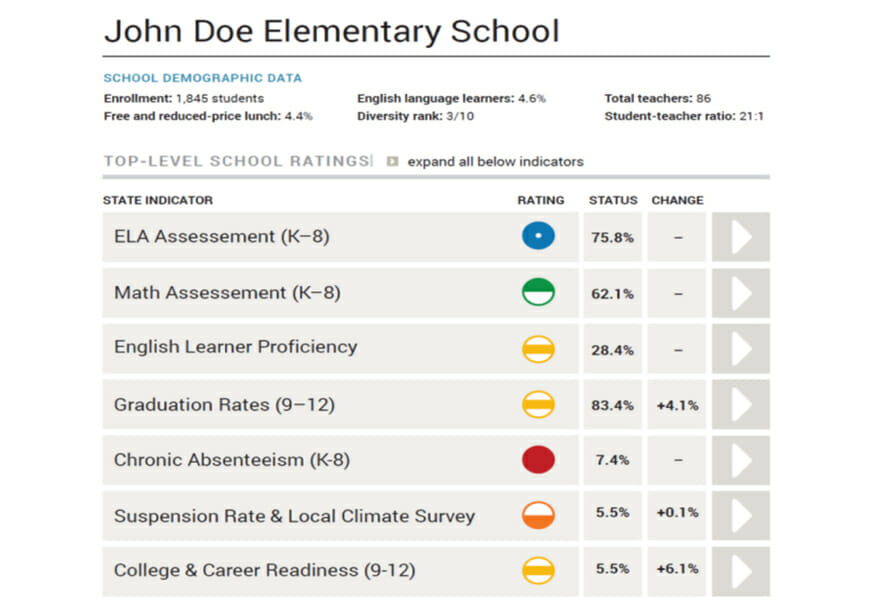
Proposed California state accountability report for schools
According to Weber, there are three “major deficiencies” in the proposed board’s proposal which adversely affect students that are most often left behind, including English language learners and low-income, Latino and African-American students. She argued that a school should receive assistance if they do not succeed in any academic metric for any of its subgroups.
“Without these critical adjustments, it appears the board will place California on a path to two disjointed systems – a state system that demonstrates little regard for the federal law, as well as a second one that will need to meet the federal statutory requirements. This bifurcation will likely confuse district administrators, educators and the public.”
Many parents in attendance took the day off from work to share their comments.
“We would like to see this rubric as an indicator of families to know exactly what is the status of the school,” said Jose Godinez who traveled from Los Angeles for the day. “California has the opportunity of witnessing this change, thanks to you.”
The state board will be discussing the school dashboard design at their November meeting and will publish the report cards for districts and schools in January. Governor Brown has until the end of the month to decide whether to sign AB 2548 and the state board has to figure out how to align the state’s accountability system with federal regulations by March.
Read more: